(7 minute read)
Happy Monday my friend, hope you've had a restful weekend and are ready for another week ahead.
There have been a lot of things in the world of health and wellness in recent times to touch on, but there have been a couple of things that have been on my mind this week that I wanted to share with you.
The most impactful supplement that I take
So this is of course entirely subjective in terms of it being my favourite supplement.
Having said that, it is one that has interesting data behind it for supporting one of the most important pillars of health: sleep.
Now if you know me, I love my sleep.
I absolutely need 7-8 hours to function in the way that I want to function.
So you can imagine the kind of zombie-state I was in when my daughter arrived and for 9 weeks sleep was a total myth 😆 (thankfully she sleeps well now).
Now you might think I'm going to say the supplement in question is magnesium glycinate - which is a great supplement it has to be said.
But it's not that.
The supplement that I absolutely swear by for sleep is glycine.
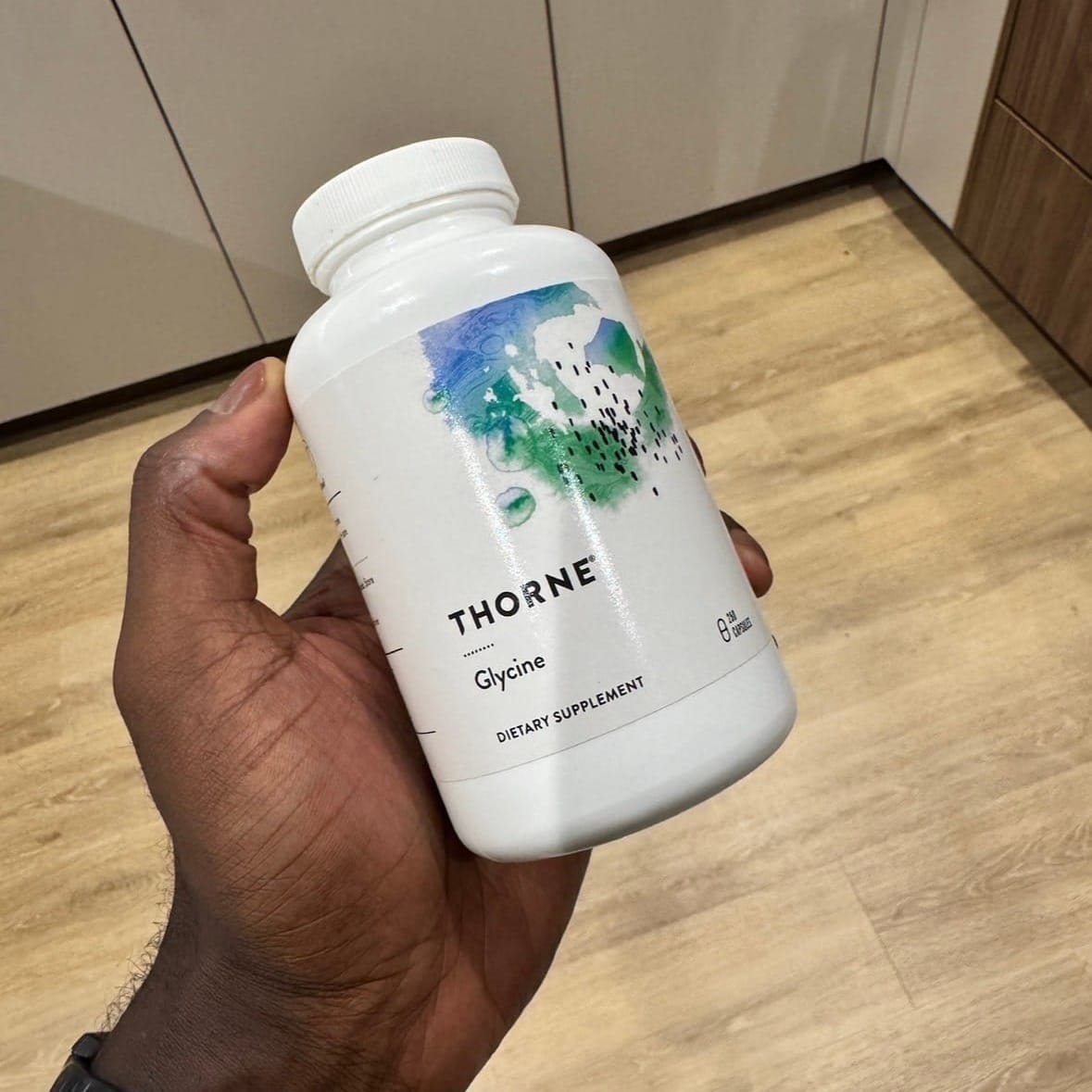
Glycine is an amino acid and a building block of protein - but it also acts as a neurotransmitter as well, which is where its effectiveness for sleep comes in.
When I think about supplements that I want to use long-term I think about two things:
- genuine efficacy (ie are there studies that show it performs well in the area I want it to improve)
- safety (very important)
Glycine ticks both of these boxes.
A randomized controlled trial titled Subjective Effects of Glycine Ingestion Before Bedtime on Sleep Quality took 11 volunteers (8 female, 3 male) who were experiencing unsatisfactory sleep and gave them either 3g glycine, or a placebo.
The study demonstrated the following improvements in sleep:
- Decreased latency to sleep onset (in plain English, a much shorter time to fall asleep)
- Decreased latency to short wave sleep (decreased time to short wave sleep, which is where a lot of our metabolic repair processes occur such as muscle and tissue repair, immune signalling and more)
- Improved subjective sleep quality (all subjects reported that they felt their sleep was better)
- It also lessened daytime sleepiness, and helped subjects perform better in memory recognition tasks
So yes, a pretty robust outlook on glycine (admittedly a small sample size, but robust nonetheless).
How does glycine actually help with all of this then?
Vasodilation
Glycine helps to reduce core body temperature through vasodilation (a really important factor for getting to sleep fast and staying asleep).
The widening of the blood vessels allows for better flood flow to the hands and feet; this then creates a lowering of core body temperature, creating the ideal scenario for a quick transition to sleep.
Having a hot shower/bath before bed can also help improve sleep in the same way: widening of blood vessels = improved blood flow = lowered core body temperature = better sleep.
Brain clock
The suprachiasmatic nucleus (SCN) is the master clock in the brain that controls circadian rhythm, and one of the things it does in relation to sleep is control night-time temperature downshift.
Glycine helps this part of the brain achieve this goal, helping to achieve that cooler body temperature, leading to a faster onset of sleep.
The practicalities
So how does this work for you and me? In simple terms:
- 3g of glycine (I personally use 5g but I worked up to it)
- Take 30-60 minutes before bed
- There is evidence that a 9g dose is safe and showed no adverse effects (but you probably don't need to go that far)
What is interesting is that when I say I don't notice many 'acute' and noticeable benefits of most supplements, that rings true.
If I take Vitamin D, I don't 'feel' immune improvement for example.
When you prioritise health, things tend to just work in the background.
But I've been using glycine for 3+ years and it is always one that I notice a huge benefit for sleep.
Definitely something worth looking into friends.
The psychology of health advice from friends and family
On my Instagram story the other day I discussed the importance of repetition when it comes to your nutrition habits, and I received a very interesting and thought-provoking response (one that the lady was happy for me to share):

It told me this: many of us struggle to make change to our health when we are advised by friends and family - even if we know they're right.
I did a bit of digging, and found that there is a lot of psychology behind this.
And much of it sits behind the Psychological Reactance Theory (otherwise known as PRT).
Coined by psychologist Jack Brehm in 1966, the theory states that "when an individual feels that their freedom or control is being limited or threatened by the advice being given to them, they are motivated to protect their autonomy".
Why this is interesting in the context of health is that - as we see in the screenshot above - people often know what to do when it comes to improving health and often appreciate that those closest to them are saying the right thing when giving them advice.
But instead of taking it, they reject it out of a desire to not be controlled.
Counterproductive, I know.
But why does this happen? There are a few potential reasons:
- When advice comes from someone close, it can feel more like control rather than information. Receiving it from a third-party (ie me!) creates a satisfactory gap for action to be taken
- Advice from those close to us can feel like criticism, and increases the likelihood of it being rejected
- With close friends and family, it's not just the information that is being received, it is the entire dynamic of the relationship (emotional baggage, past issues etc. Some people find it hard to look past these
- Third-party information givers aren't a threat to someone in the sense of control, so the information is freely taken
I find it really interesting because while I think health advice is health advice, I totally get the psychological element to it.
And it shows that it isn't all about knowledge and discipline, as some people have other barriers to overcome.

So if you're someone trying to give health advice to a friend or family member - here's what you should do to help the message land:
- DON'T come from a place of superiority; this never works. Instead, offer suggestions from a place of humility (while also setting the example in your own life)
- Position it as if they're the ones making the choice. So perhaps you might start speaking about the benefits of getting more fibre into one's diet and you could say "you could try adding some chia seeds to your recipes?" instead of YOU MUST DO THIS
- Another good one is to cite evidence and research, so it looks like the information is external to you (and you're just the messenger). This helps it seem less like your information, and instead something useful that you came across that you want to pass on
I get it though; I've been there before.
You give health advice to a family member that you think will benefit them greatly, and they bat it away without so much as a conversation.
It can feel very annoying, and somewhat deflating.
But if you shape your advice in a slightly different way - knowing that there's a chance that if you don't it will feel like control - it's a much better step (note to myself as well).
And it will go a long way to reducing reactance, and allowing your message to be heard by those closest to you.
A little gift to you guys...
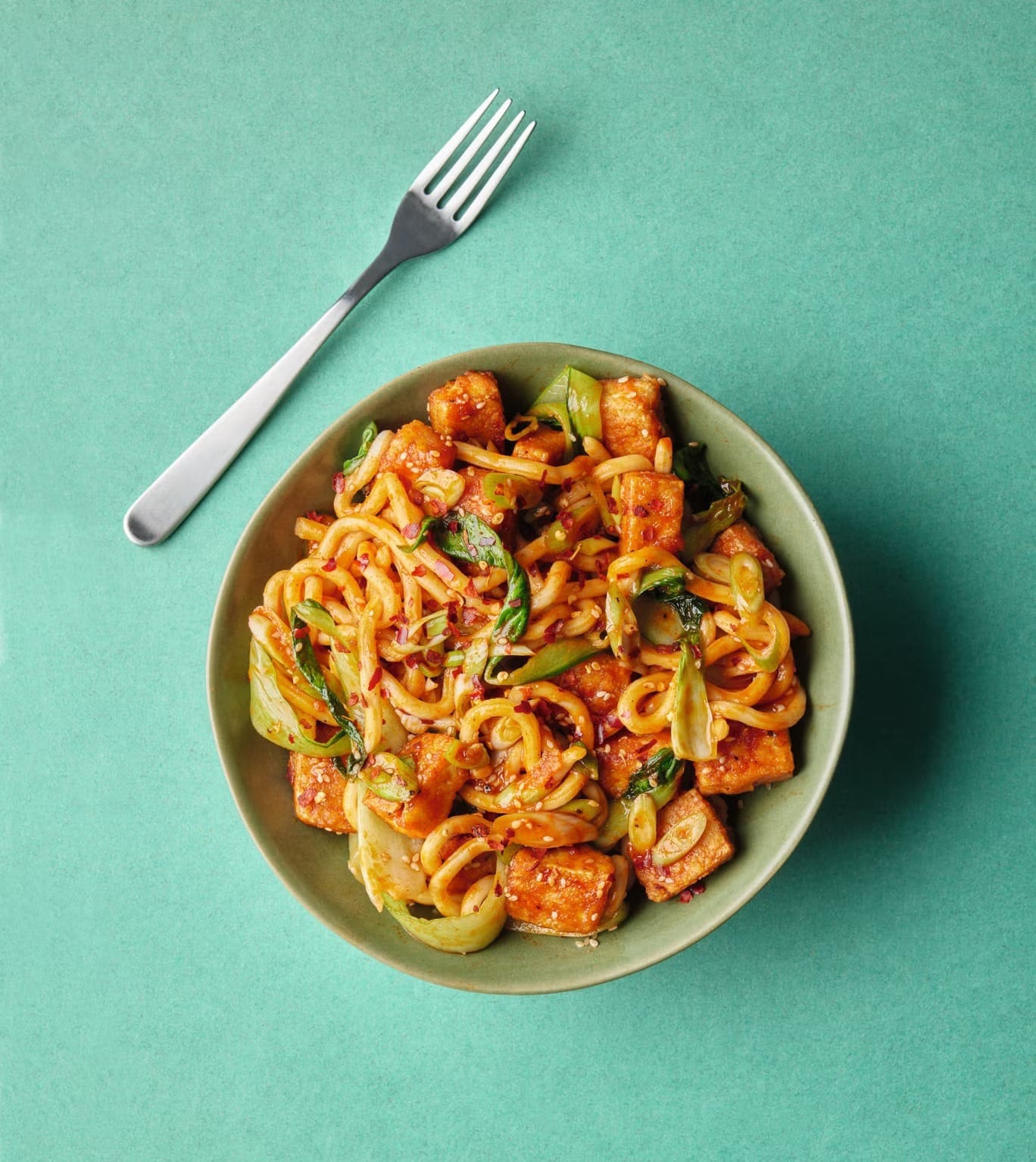
Thought I'd share my favourite recipe from my debut cookbook Plant Fuel with you guys, and it's the Gochujang Tofu Stir Fry.
Simple, flavourful, quick to make, and high in protein.
I think you guys will love this one!
Serves: 2
Protein: 34g per serving | Fibre: 7g per serving
Prep time: 10 minutes | Cook time: 15 minutes
Ingredients:
280g firm tofu
2 tbsp cornflour
200g udon noodles
2 tbsp extra-virgin olive oil
250g pak choi, sliced
2 spring onions, sliced
Pinch of chilli flakes, to garnish
For the sauce:
4 tbsp gochujang paste
4 tbsp toasted sesame oil
2 tbsp agave nectar
3 garlic cloves, minced
2 tbsp sesame seeds
3 tbsp soy sauce
½ tsp black pepper
Method:
1. Press the tofu for at least 10 minutes to remove excess water, then cut into bite-sized pieces.
2. Transfer the tofu to a bowl and coat it in the cornflour.
3. Cook the udon noodles according to the packet instructions.
4. At the same time, heat the olive oil in a medium to large wok-style pan, then fry the tofu over a medium to high heat for 6-8 minutes, or until all the pieces are light golden brown.
5. Remove the pan from the heat, set it aside and wipe away any remaining oil from the pan.
6. When the noodles are almost cooked, add the pak choi to the noodle pan for 2-3 minutes to lightly blanch and wilt.
7. Once ready, drain the noodles and pak choi in a colander, and briefly run them under cool water. Remove as much water as possible.
8. In a small bowl, whisk together all the sauce ingredients.
9. Coat the tofu with half of the sauce, then return the pan to a medium heat.
10. Add the noodles, pak choi, spring onions and the remaining sauce to the pan, mixing well to ensure all the ingredients are coated. Fry for 2-3 minutes until hot.
11. Garnish with a sprinkle of chilli flakes and serve.
Enjoy friends - and stay healthy!
Jeff
Who am I? 👋🏾 I'm Jeffrey Boadi, a long-time plant-eater, author, and health and wellness expert. I've been posting about nutrition and wellbeing for a long time on Instagram and X, have recently released my debut cookbook Plant Fuel, and am also a new (ish) dad, having became a father for the first time in April last year!
Every Monday I publish this newsletter where I share health information, guidance, recipes and tools to help you live better - and I really enjoy doing it.
If you find any of my newsletters interesting, I'd love for you to reply (I respond to all replies!) and continue the conversation - or if you want to let me know that it was good. Or if it sucked. Either way, it's all good 😄
And if you wanted to share the subscribe link with a friend, you can find it here.